

Alkaline or PEM electrolyzers: Which should you choose?
September 09th 2026
Updated July 2026
What’s New: Key Findings from the Latest Industry Research
Two recent publications offer an opportunity to revisit the alkaline vs. PEM comparison we produced in 2024 and to establish an up-to-date view of real-world electrolyzer performance: Electrolyzer Price and Performance Survey 2026 — June 2026, BloombergNEF; and Electrolyzers for Hydrogen Production: Technical and Economic Characteristics — February 2026, World Bank. As technology and the market have evolved, some data points have moved, as noted below.
That leaves us with alkaline and PEM electrolyzers—the two major technologies deployed most widely around the world for hydrogen production. Alkaline electrolyzers are the most common technology on the market today and are likely to remain so in the coming years, representing between 70-90% of annual electrolyzer shipments worldwide*. However, interest in PEM electrolyzers is growing, with some companies wondering which—PEM or alkaline electrolyzers—is the better choice for their installation.
The key findings buyers should be aware of:
- PEM has scaled past 50 MW in operation, but long-term field data at that scale remain limited
- Alkaline still dominates deployment, at 84% of electrolyzer projects currently under construction worldwide
- Alkaline is slightly more efficient than PEM at system level: ~54.6 kWh/kg vs. ~55.1 kWh/kg for Western systems in 2025 (BNEF 2026)
- Headline efficiency and CAPEX figures are not directly comparable; understanding each OEM’s scope of supply is essential to compare apples-to-apples
- There are no industry standards for how degradation, efficiency, minimum load, or restart times are calculated; most figures are lab-derived and have yet to be verified by field operations, so buyers need to be very careful when comparing and assessing technologies
- The industry is maturing, and proven references are becoming essential — only real operating experience can substantiate and guarantee the performance an OEM states
- Alkaline has advanced materially — new zirconia separators, nickel-alloy electrodes, and digital diagnostics
Read the full BNEF Electrolyzer Price and Performance Survey 2026 (Note: Full report access requires a BloombergNEF subscription).
Understanding the Available Types of Electrolyzers
Today, green hydrogen is typically produced using one of four technologies: alkaline, PEM, solid-oxide electrolyzer cell (SOEC), and anion exchange membrane (AEM). Of these, solid-oxide and AEM are the most recently developed, with a shorter track record in the market. SOEC technology has advanced to Technology Readiness Levels (TRLs) 6–8 and is currently in the demonstration and pilot deployment stages. As a more recent technology, AEM has achieved TRLs 5–8, with several pilot-scale projects already underway.
That leaves us with alkaline and PEM electrolyzers — the two major technologies deployed most widely around the world for hydrogen production. Alkaline electrolyzers are the most common technology on the market today and are likely to remain so in the coming years, representing 84% of electrolyzer projects currently under construction worldwide. However, interest in PEM electrolyzers is growing, with some companies wondering which — PEM or alkaline — is the better choice for their installation.
Alkaline and Pressurized Alkaline Electrolyzers: Robust Technology for a Range of Applications
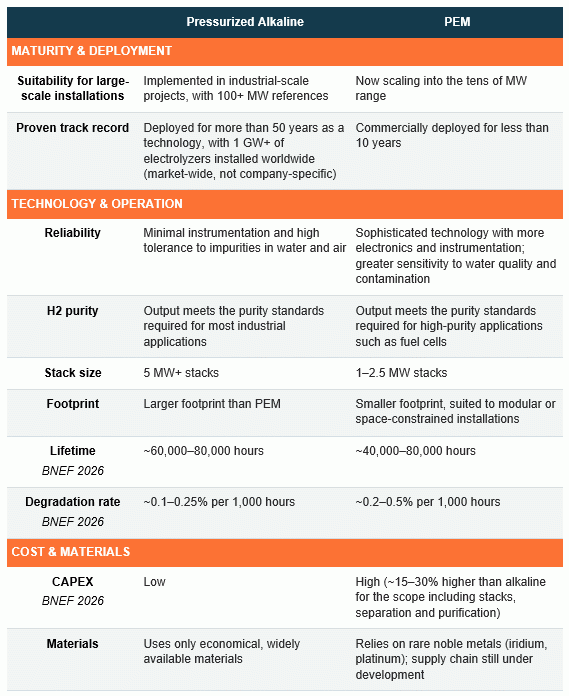
Within the realm of electrolyzers, alkaline is the most established and mature technology. It’s been in use for decades — including in 100+MW industrial projects — showing performance and durability, and its deep history means that it is generally easier to monitor, maintain, and operate. It offers the lowest capex due to the use of more economical materials and the deployment of larger stacks, enabling economies of scale. Its robust technology makes it suitable for any environment, including harsh industrial environments, and it boasts the highest tolerance for raw feed water.
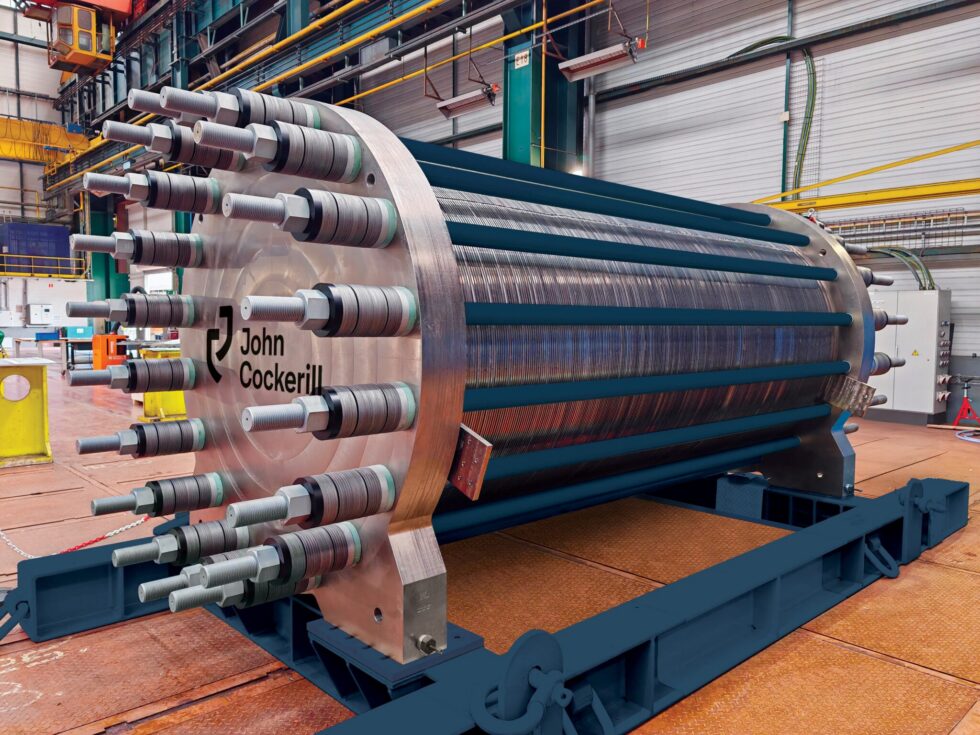
A subsection of alkaline electrolyzers, pressurized alkaline electrolyzers offer these same advantages with the addition of innovative features better suited for today’s needs. Still produced without noble or rare materials, they’ve been redesigned to operate with more reactivity and dynamism, making them able to follow variable energy requests — common when renewable energy is used for power. They integrate pressurizing capabilities, reducing the need for costly downstream compression and bringing additional advantages including footprint and cost reduction at system level. For over 30 years, John Cockerill has been positioned in large-scale pressurized alkaline electrolysis. Recent moves by historically atmospheric players such as Nel and Thyssenkrupp Nucera, toward integrating pressurized alkaline into their offerings confirm the need for such technology.
Recent advances in alkaline technology confirm that this is not a static platform. Developments in separator technology — in particular, the transition from traditional diaphragms to advanced composite separators such as zirconia-based materials — are enabling lower gas crossover (typically below 1–2% under standard operating conditions), improved mechanical stability, and more reliable operation at higher pressures (20–30 bar and above). These developments represent a key step in modernizing alkaline technology, especially for pressurized and large-scale industrial applications.
On the electrode side, high surface area nickel-based electrodes, including Ni-Fe and other alloyed structures, are enabling current densities in the range of 0.3–0.6 A/cm² at industrial conditions while maintaining long lifetimes. At the stack level, more uniform compression and refined internal geometries are helping maintain consistent operating conditions across large active areas — particularly relevant as systems scale up.
Digital tools and advanced diagnostics are also increasingly used to improve reliability and operational insight. Real-time monitoring and impedance-based diagnostics enable early detection of performance deviations and support predictive maintenance strategies, particularly in large-scale installations. These advances directly address key finding #7 from the research summary above.
PEM Electrolyzers: A Technology for Specialized Applications, Now Scaling
PEM electrolyzers were originally designed for transportation projects, which require an optimized footprint, flexibility, and high-purity output. They also offer a higher pressurized output, which is useful when direct liquefaction is required after production.
PEM electrolyzers offer advantages in terms of compact design, high current density (typically 2 to 3 A/cm², versus around 0.3 A/cm² for alkaline per BNEF 2026), and fast response, making them well suited for applications requiring high-purity hydrogen and flexible operation in controlled environments. However, these advantages come with trade-offs, including higher material intensity, increased system complexity, and greater sensitivity to operating conditions, which can influence both cost and long-term performance in large-scale industrial applications.
On scale: PEM projects have now begun scaling into the tens of megawatts, with several installations above 50 MW recently commissioned — meaningful progress from where the technology stood only a few years ago. This addresses key finding #1. However, field data on long-term performance at scale remain limited, and independent research suggests that OEM claims on lifetime and degradation warrant independent verification before being used as the basis for investment decisions.
On efficiency: Counterintuitively, alkaline electrolyzers are generally slightly more efficient than PEM at the system level (BNEF 2026) — not the other way around. Commercial PEM electrolyzers are engineered to operate at higher current densities than alkaline systems, reducing the required amount of costly platinum-group-metal (PGM) catalysts and polymer membrane materials. However, this increase in current density generally comes at the expense of efficiency. Based on benchmark power consumption of the full electrolyzer system (power electronics, stack, gas separation, and H₂ purification) in 2025, Western alkaline systems consume approximately 54.6 kWh/kg versus 55.1 kWh/kg for Western PEM systems. The same higher-current-density design also tends to degrade faster: alkaline systems show a degradation rate of roughly 0.1–0.25% per 1,000 hours compared with roughly 0.2–0.5% per 1,000 hours for PEM (OEM promise; limited field validation — actual rates may be higher under dynamic operation; BNEF 2026). Because OEMs often measure efficiency across different system scopes and boundaries, buyers should require like-for-like comparisons before drawing conclusions (see key findings #3 and #4).
On lifetime: PEM stack makers are now quoting shorter lifetimes than they did in 2024 (BNEF 2026) — averaging just under eight years. Independent analysts caution that real-world figures may fall toward the lower end of the 40,000–80,000-hour range, so OEM lifetime numbers should be treated as upper-bound claims rather than confirmed field results. See key finding #5.
On materials: PEM electrolyzers rely on noble metals such as iridium and platinum, which introduces supply chain considerations, although ongoing developments aim to significantly reduce material intensity. Iridium usage today is typically in the range of 0.5–2 mg/cm², with ongoing R&D targeting meaningful further reductions. In addition, the use of fluoropolymers in PEM systems is drawing increasing regulatory attention, particularly in Europe in the context of evolving PFAS regulations.
Comparison: Pressurized Alkaline vs. PEM (market view)
Choosing Between Alkaline and PEM
There is no single electrolyzer technology that performs better across all dimensions. The right choice depends on your application. When evaluating your options, you will need to consider factors specific to your project: cost of electricity, power supply variability, pressure output requirements, available footprint, project scale, and operating conditions. Key considerations include:
- Pressurized alkaline offers benefits over atmospheric: An enhancement to traditional alkaline electrolyzers, pressurized alkaline requires less energy, more easily follows variable renewable energy load, and offers the ability to feed hydrogen directly into an industrial process. In addition, by including pressurization capabilities within the electrolyzer, it reduces or eliminates the need for additional compression, cutting overall costs and avoiding the capex and opex required for a downstream compressor.
- A large single stack is better suited for scaling up: 5-MW stacks are better suited than smaller stacks for large-scale industrial hydrogen production facilities. While PEM offers a smaller footprint, its stack size makes it better suited for specialized instances where compact design, high purity, or fast dynamic response is the primary requirement.
- Factor dynamic operation into your technology decision: As electrolyzers are increasingly coupled with intermittent renewable energy, not only ramping capability but also the impact of dynamic operation on degradation and lifetime becomes a key consideration. Most OEM degradation guarantees are based on steady-state or accelerated indoor testing — buyers should ask OEMs directly how their guarantees are derived and whether they reflect real operating profiles. This is the detail behind key finding #5.
- Treat published minimum-load figures with caution: Reported minimum operating loads can be understated because some are derived using oversimplified assumptions (BNEF 2026) — for example, dividing a stack’s minimum load by the number of stacks and assuming each can be independently controlled. Real operating constraints, such as other equipment from the balance of stack, and feedback from field operations suggest actual minimum loads may be higher than reported.
- Scrutinize ramp speed and restart times: Ramp-speed figures are often overstated because they are derived from stack-level observation rather than full-system testing. Restart times in particular have been revised upward: in the latest BNEF survey, PEM suppliers report cold-start times averaging 33 minutes (versus 5 minutes previously) and warm-start times of 3 minutes (versus 1 minute). Buyers relying on fast dynamic response should validate these figures against full-system data (BNEF 2026).
- PEM technology requires costly scarce metals and fluoropolymers: PEM electrolyzers rely on iridium and platinum. These materials contribute to a higher overall cost, and their scarcity introduces supply chain risk. IRENA estimates that worldwide iridium production is only sufficient for 10–12 GW of electrolyzers per year. Ongoing R&D is targeting reduced precious metal loading, but this is not yet reflected in commercial products at scale. In addition, the fluoropolymers used in PEM systems are drawing increasing regulatory scrutiny in Europe under evolving PFAS regulations.
In general, alkaline and pressurized alkaline electrolyzers are the best fit for most industrial applications. They are suited for large-scale installations, can be easily scaled as needs change, offer robust and reliable technology, and produce output that meets the requirements of most industries — and as key finding #2 confirms, they continue to represent the dominant choice globally, accounting for 84% of electrolyzer projects currently under construction. Those operating in transportation or other specialized applications — particularly where a compact footprint, high-purity output, or fast dynamic response is paramount — may find PEM to be the better choice.
And whatever technology you select, the choice of partner matters as much as the choice of technology because a supplier with real-world operating experience and a portfolio of delivered projects is essential to de-risk the investment. Proven references are what allow performance to be stated, guaranteed, and relied on across the life of a project — and they are the clearest evidence that a technology will behave in the field the way it does on paper.
Sources: Electrolyzer Price and Performance Survey 2026 – June 2026, BloombergNEF; Electrolyzers for Hydrogen Production: Technical and Economic Characteristics – February 2026, World Bank
For additional information or support, contact us.
If your organization is exploring electrolyzer options, John Cockerill has advised companies on the deployment of large-scale pressurized alkaline electrolyzers for more than 30 years.