

Anticipation, Not Reaction: How the John Cockerill Electrolyzer System Controller Supports Lower-Cost Green Hydrogen

November 17th 2026
Key takeaways
- After financial close, plant operation remains one of the key levers for optimizing LCOH throughout the asset’s lifetime.
- Variable renewable power, a modular plant, and the inertia of electrolyzers make that operation hard to coordinate with basic, reactive control.
- The Electrolyzer System Controller uses a power forecast from the energy management system to anticipate changes in power availability, prepare units ahead of expected increases, and select which units to operate based on their condition and operating history. Depending on the selected operating strategy and plant configuration, it can also manage standby states to reduce unnecessary start-stop cycles.
- The value the Electrolyzer System Controller brings to your plant depends on your project. It grows with the variability of your power profile, the number of units to coordinate, and the operating strategy you select.
When you build a large-scale green hydrogen plant, you are committing to a single number for the next two decades: the levelized cost of hydrogen (LCOH), what every kilogram costs across the life of the asset. By the time a project reaches financial close, most of the major levers on the LCOH have already been pulled. You have secured competitive renewable power, selected efficient electrolyzers, sized the plant against your offtake, and structured the financing. The design is sound.
What remains is what happens after commissioning: how the plant is operated, hour by hour, against power that never stops changing. This lever stays open for the entire life of the asset, and it is one where advanced control can make a difference. How efficiently your plant converts available power into hydrogen, and how often its equipment is heated and cooled (thermal cycling), depends in part on how those operating decisions are coordinated.
This article explains what makes those decisions hard in a large, renewable-powered plant, how the Electrolyzer System Controller approaches them, and why the value it delivers depends on your project.
Why Renewable Power Makes Plant Control Hard
A Modular Plant Multiplies the Control Decisions
A large plant is not one machine. A 640 MW facility, for example, can be configured as 64 Smallest Controllable Units (SCUs). An SCU is the smallest block of the plant that the control system can bring into or out of production on its own. In this example, each SCU represents about 10 MW of capacity through two 5 MW stacks. Every SCU draws on solar or wind power that can fluctuate throughout the day, and something has to decide, second by second, how many SCUs should be producing, how the available power should be shared across them, and which ones should be prepared or kept on standby.
Three characteristics make that decision hard, and they compound one another. Renewable input is variable, so operating decisions never stop. The plant is modular, so you are coordinating many units rather than a single production block. And electrolyzers have thermal inertia: they behave more like an oven than a light switch. It takes time to prepare them before they can produce hydrogen.
A basic control system responds to these conditions after they occur. An advanced control strategy uses information about how much power is expected to be available to anticipate changes and prepare the plant in advance.
The Cost of Reactive Control: Equipment Cycling and Lost Operating Opportunity
Reacting rather than anticipating affects your plant in two ways.
The first is equipment cycling. An SCU that is not producing sits in one of two states: Hot Standby, where it is kept warm and ready to return to production, or Cold Standby, where it is not. Moving back and forth between these states and production adds thermal and mechanical stress to electrolyzer equipment.
Avoiding unnecessary operating-state transitions and thermal cycling can help support equipment availability and long-term asset lifetime, depending on the selected operating strategy and plant constraints.
The second is how well your plant uses the power available to it. A basic approach tends to bring units on and off in a fixed sequence. The Electrolyzer System Controller instead decides how many SCUs should be producing and how the power is shared across them, based on your plant’s selected operating strategy and its operating limits. Your plant’s configuration adapts to the power you actually have.
No single efficiency figure applies to every plant. The aim is to make better use of the power you have.
Electrolyzer System Controller Value Grows With Variability and Plant Size
The value of an advanced control layer is not the same for every electrolytic hydrogen project. It depends on three characteristics of your operating environment.
Power profile. A plant running on stable power faces a different control challenge from one running on variable wind or solar. The more your power varies, the more operating decisions there are to coordinate.
Plant size. The more SCUs your plant has, the more units there are to schedule, share power across, and keep ready.
Operating strategy. The Electrolyzer System Controller supports different operating strategies, each designed for a particular kind of power profile, from stable grid supply to variable renewables. The strategy you select shapes how the Electrolyzer System Controller manages your plant.
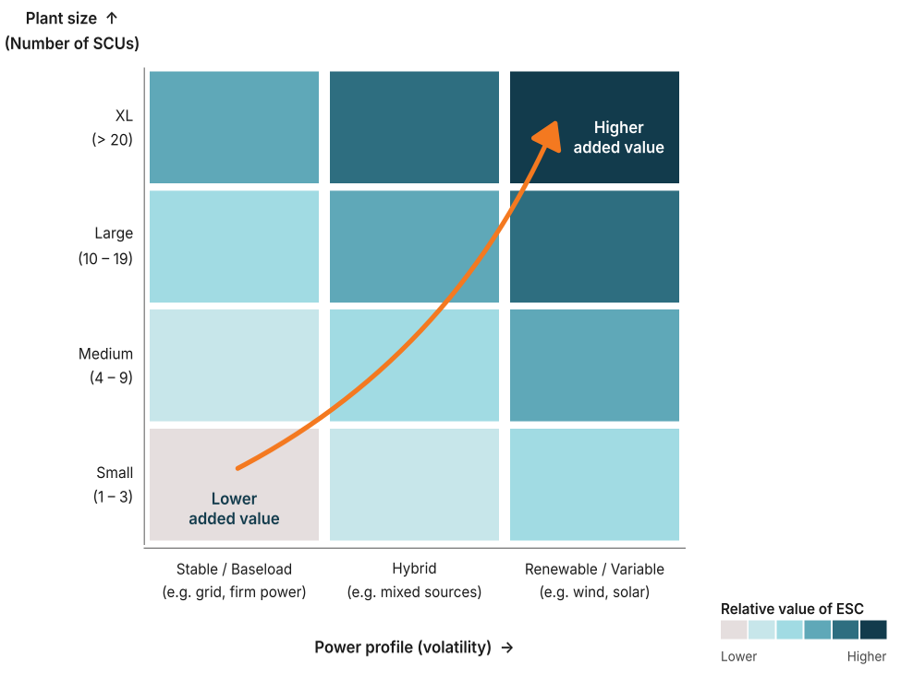
Electrolyzer System Controller value increases with power profile variability and plant size.
A Clear Split Between the Electrolyzer System Controller and the Energy Management System
In a large plant, the Electrolyzer System Controller and the energy management system each have a distinct job.
The energy management system (EMS) is the optimization layer above the plant. It uses electricity price forecasts and renewable production forecasts to schedule and optimize hydrogen production. Depending on your project, it may pass its instructions to the plant directly or through an intermediate energy control system.
The Electrolyzer System Controller is the layer that turns those instructions into coordinated operation of the SCUs. It works from two inputs: the target power setpoint, which tells the plant how much power to draw right now, and the power forecast, which tells it how much power to expect. From those, the Electrolyzer System Controller determines how many SCUs should be producing, how power is shared across them, which to prepare or hold on standby, and which individual units to select. It does this in coordination with the plant main controller, which runs the equipment itself and reports each SCU’s status back to the Electrolyzer System Controller.
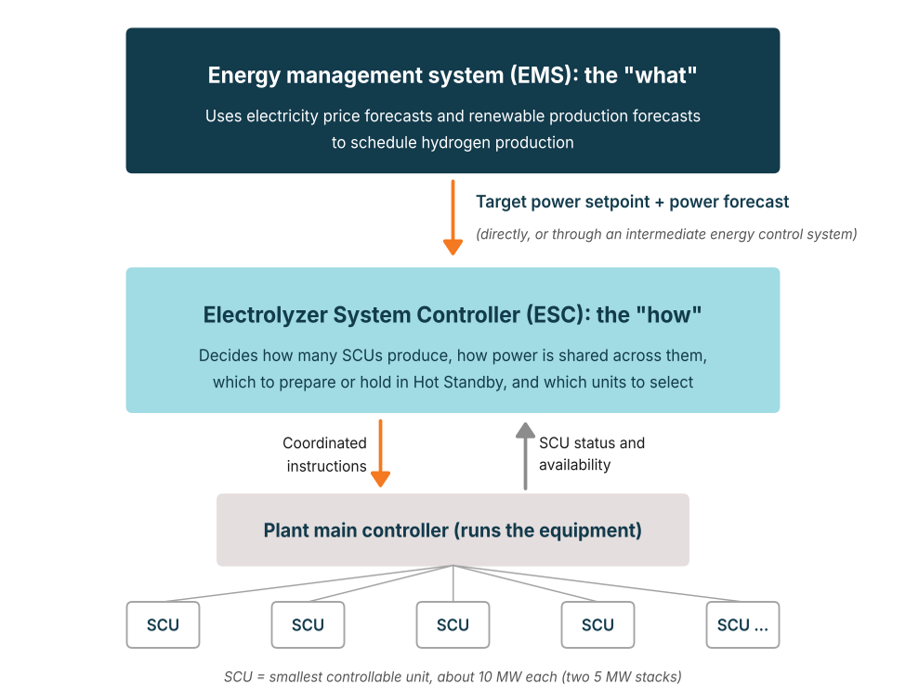
How the EMS and the Electrolyzer System Controller divide the work.
That boundary matters at procurement and integration. Your energy management and trading strategy stays with the EMS and the team that owns it. The Electrolyzer System Controller decides how the electrolyzers meet the power it sets. The information passed between the two is clearly defined, so each layer stays separate while the two work together.
Anticipatory Control: Acting on a Power Forecast
The Electrolyzer System Controller shifts your plant from reacting to anticipating. Rather than waiting for power to change and then responding, it uses the power forecast to see changes coming and prepare selected SCUs ahead of them.
Several mechanisms do the work.
Hot Standby: Reducing Cold Starts to Improve Electrolyzer Availability and Lifetime
Hot Standby is central to the strategy. When available power drops temporarily and the forecast shows it coming back, the Electrolyzer System Controller can keep selected SCUs in Hot Standby rather than returning them to Cold Standby. When power returns, those units go back into production without running the full preparation sequence from cold.
This reduces unnecessary thermal cycling and helps your plant respond faster when power comes back.
Preparing Units Before the Power Arrives
Renewable power does not always change smoothly. Short-lived dips happen throughout the day, while longer changes may call for a different plant configuration. The Electrolyzer System Controller combines the power forecast with the current state and availability of each SCU to decide when additional units should be prepared.
When the forecast shows more power coming, the Electrolyzer System Controller can start moving selected SCUs from Cold Standby toward Hot Standby before that power arrives. Your plant has the right units ready ahead of the change, rather than catching up after it.
Selecting SCUs by Condition, Not a Fixed Order
When a change in configuration means bringing an individual SCU into or out of production, the Electrolyzer System Controller applies a dedicated selection strategy to decide which one.
Depending on the selected operating strategy and project configuration, SCU selection can take into account relevant operating information, such as temperature, pressure, voltage degradation, accumulated production hours, start-stop history and current operating state, together with operator-defined parameters.
Unit selection therefore does not have to follow a fixed order. The Electrolyzer System Controller takes the condition and history of your units into account, and avoids relying on the same units every time when other available units can be used within your operating strategy and limits.
Redistributing Power When an SCU Goes Offline
An SCU can become unavailable because of a fault, maintenance work, or another plant-level condition. When that happens, the plant main controller reports the change to the Electrolyzer System Controller, which removes that unit from its control and selection decisions and reassesses how much operating capacity your plant has.
Where enough capacity remains, the Electrolyzer System Controller redistributes the required power across the remaining available SCUs according to your operating strategy and limits. Your plant keeps making effective use of the electrolyzer capacity it has.
A Fifteen-Minute Cloud Cover Event Without a Cold Start
Consider a single SCU running at its full 10 MW on solar. A cloud moves in and reduces available power to 2 MW for fifteen minutes.
A reactive approach may stop the unit, then run a complete cold-start sequence once enough power returns.
The Electrolyzer System Controller can instead use the power forecast to see that the drop is temporary and keep the SCU in Hot Standby. When the sun returns, the unit goes back into production without the full preparation sequence from cold.
Your plant avoids an unnecessary cold start and the thermal cycling that comes with it, and is producing again sooner.
Lowering LCOH on Both Operating and Capital Costs
The Electrolyzer System Controller contributes to both sides of the cost equation.
Optimizing your project’s operating expenditure (OPEX). Coordinating how many SCUs are producing and making effective use of available power supports efficient plant operation. Forecast-based management also reduces unnecessary preparation sequences and the energy they consume.
Optimizing your project’s capital expenditure (CAPEX). Reducing unnecessary start and stop cycles and thermal cycling supports long-term equipment availability and lifetime.
How much this moves your LCOH depends on your project: your power profile, your plant size and number of SCUs, and your selected operating strategy.
These gains are not a correction to a badly designed plant. You can have competitively priced power, well-specified electrolyzers, and a sound configuration, and still face significant operational complexity once your plant is exposed to variable power. The Electrolyzer System Controller is built to manage that complexity.
Developed In-House, Tuned to John Cockerill Electrolyzers
John Cockerill develops the Electrolyzer System Controller in-house, with control strategies designed around the operating characteristics of its own electrolyzer technology and refined through engineering and operational experience.
Because the control logic and the electrolyzers are developed within the same organization, the control strategy is aligned with how the equipment physically behaves and what it needs to operate well. The result is a control layer built specifically to coordinate large-scale, modular electrolyzer plants under changing power conditions.
Model the Electrolyzer System Controller Against Your Plant’s Power Profile
If you are modeling the economics of a large-scale green hydrogen project, the control layer deserves a place in that operating model. The John Cockerill Hydrogen team can walk you through how the Electrolyzer System Controller would operate against your plant’s specific power profile, configuration, and production targets.
Contact us
Let’s explore what forecast-based SCU control could mean for your project’s operational performance and LCOH.